Alphabet Inc. is set to report fiscal first-quarter 2026 results after the U.S. market close on April 29. In the lead-up to the release, options activity points to a broadly constructive bias, with institutional flows signaling upside positioning alongside active downside hedging.
The options market is pricing an implied move of roughly ±6.23% for the earnings week, corresponding to a range of $322.9 to $365.9 based on the current share price of $344.4. Block trades highlight a clear tilt toward bullish strategies: a $830,000 net-debit bull call spread (long May 8 $385/$410 calls) and a synthetic long position (long June $400 calls paired with short $280 puts), both expressing upside expectations. At the same time, sizable purchases of deep out-of-the-money May $210 puts suggest demand for “disaster insurance,” underscoring a dual-track approach of pursuing upside while guarding against tail risks.
Earnings Preview and Market Expectations
Consensus estimates (USD, market data):
Revenue: $106.6 billion, up 19.56% year-on-year
Adjusted EPS: $2.62, up 30.11%
EBIT: approximately $36.55 billion, up 27.23%
Options Positioning: Bullish Skew with Defined Risk
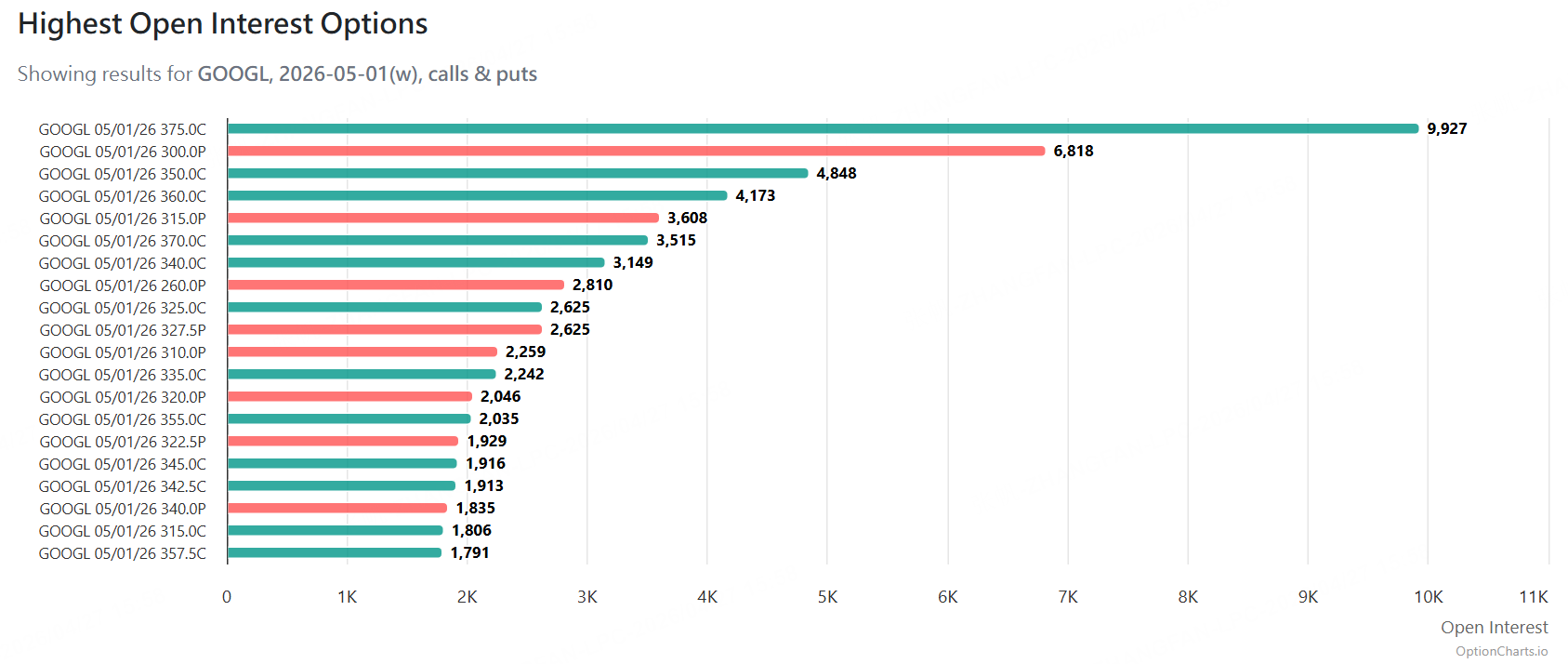
Open interest concentration.
For options expiring May 1, call positioning is notably concentrated. The $375 strike call holds the largest open interest (9,927 contracts), suggesting a key resistance level, while $300 puts (6,818 contracts) mark an important downside support zone. Around the current price range ($330–$360), call open interest significantly outweighs puts—for example, $350 calls (4,848 contracts) versus just 158 puts—indicating a clear bullish skew.
Implied volatility and expected move.
Implied volatility for the earnings-week expiry stands at 53.27%, translating to an expected move of ±6.23%. This implies a roughly 68% probability that shares remain within the $322.9–$365.9 range post-earnings.
Block Trades: “Smart Money” Positioning
Recent large transactions provide further insight into institutional strategy:
Bullish structures (core positioning). A bull call spread involving May 8 $385 and $410 calls, with total premium outlay of about $1.36 million, signals expectations for a post-earnings move into the $385–$410 range.
A synthetic long position—constructed via a net $700,000 debit through long June $400 calls and short $280 puts—effectively replicates long equity exposure, indicating strong conviction in upside while signaling willingness to accumulate shares at lower levels.
Tail-risk hedging. Meanwhile, nearly 10,000 contracts of May 15 $210 deep out-of-the-money puts were purchased. Such trades are typically deployed as low-cost protection against extreme downside scenarios rather than outright bearish bets.
Sentiment takeaway. Institutional flows point to a “risk-on with protection” stance: capital is primarily deployed in bullish structures, while downside hedges are layered in to mitigate tail risks.
Strategy Considerations
For options sellers, the implied range of $322.9–$365.9 suggests a relatively lower probability of strikes outside this band being tested. Writing out-of-the-money options beyond this range—such as puts below $322 or calls above $365—may offer attractive premium capture.
However, given the risks associated with naked option selling, defined-risk strategies such as iron condors may be more appropriate. By simultaneously selling calls and puts outside the implied range and purchasing further out-of-the-money options to cap losses, investors can monetize time decay while maintaining controlled downside exposure.
Comments