With the US credit rating downgraded again, is the US Treasury market poised for another turbulent moment in 2011?
In 2011, after S&P downgraded the U.S. credit rating, U.S. stocks experienced a sharp sell-off, with the S&P 500 index falling by more than 7% that day. US Treasury bonds also experienced a sharp sell-off, pushing the 10-year Treasury yield up by 16 basis points.
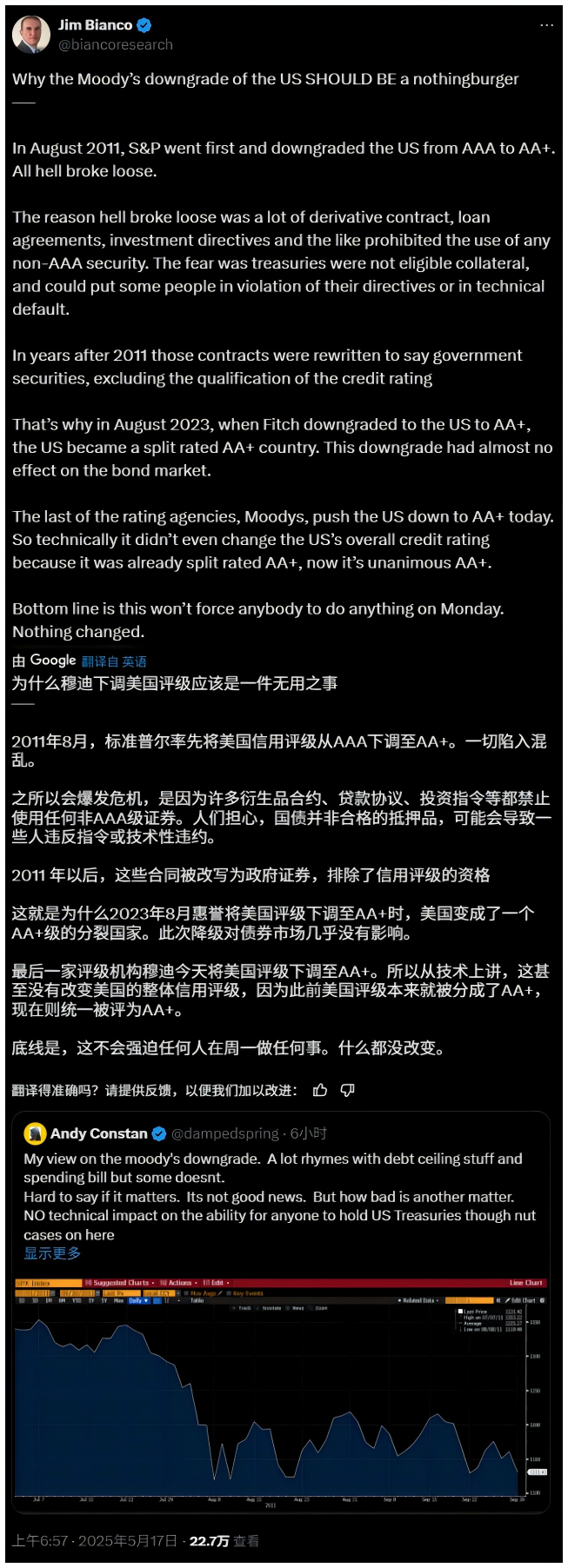
However, regarding the market reaction to Moody's downgrade of the US rating, Wall Street veteran Jim Bianco, president of Bianco Research, believes that the downgrade may be a "no-brainer" and its actual impact on the market may be "insignificant".
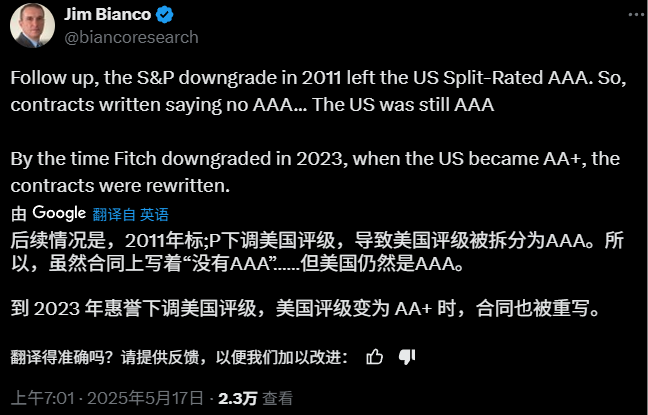
He believes that after S&P downgraded its rating in 2011,The market panic stems from the fact that US Treasury Bond may no longer meet the criteria for eligible collateral, forcing many institutions to sell US Treasury bonds.。 Bianco stated:
After 2011, these contracts were rewritten to adjust the requirements for securities to "government securities," remove specific eligibility requirements for credit ratings, and rating changes no longer trigger enforcement measures or sell-offs. Therefore, this will not force anyone to do anything on Monday, nothing has changed.
Why did 2011 trigger market panic?
Back in August 2011, when S&P downgraded the United States from AAA to AA+ for the first time, the market experienced a moment of panic, especially the US Treasury market, which suffered a sharp sell-off.
On the day of the rating downgrade, the 10-year US Treasury yield experienced a sharp sell-off, rising 16 basis points, while the 2-year Treasury yield initially rose 3 basis points.
Regarding the sharp sell-off in the US Treasury market in the early stages, Bianco posted on social media that the "sky fell" because a large number of derivatives contracts, loan agreements, and investment instructions prohibited the use of any non-AAA rated securities.
"The fear at the time was that U.S. Treasury Bond might no longer qualify as eligible collateral, which could lead some people to violate investment instructions or fall into technical default."
In other words, in 2011,Many institutions were forced to sell US Treasury bonds, triggering a moment of panic in the US Treasury market.。
It is worth noting that after an initial surge, the yield on 10-year US Treasury bonds fell sharply by 56 basis points within a month, from 3% to 2.1%. The yield on 2-year U.S. Treasury bonds fell by 9 basis points within a month. Analysts believe there are three main reasons:
Although the rating downgrade was negative for the US Treasury market, investors rushed to buy US Treasuries due to safe-haven demand, which is why the 10-year US Treasury yield fell sharply in the following month.
At that time, with the global economic slowdown and the lingering aftermath of the European debt crisis, US Treasury bonds were still regarded as the safest liquid asset.
Following the rating downgrade, investors anticipated that the Federal Reserve would further ease policy to offset the impact of the rating, leading to a surge in bond purchases and lowering US Treasury yields.
It's very different now.
The problem that arose on the day of the 2011 US Treasury yield downgrade no longer exists because...The system has been completely adjusted, and rating changes will no longer trigger coercive measures or sell-offs.。
According to Bianco's analysis:
"After 2011, these contracts were rewritten, changing the requirements for securities to 'government securities' and eliminating specific eligibility requirements for credit ratings."
It was precisely because of this change that Fitch's downgrade of the US rating to AA+ in August 2023 had almost no impact on the bond market.
Finally, Bianco stated that technically speaking, Moody's downgrade of the U.S. credit rating did not even change the overall credit rating of the United States, because the U.S. rating was previously divided into AA+, but now it is uniformly rated AA+.
Comments