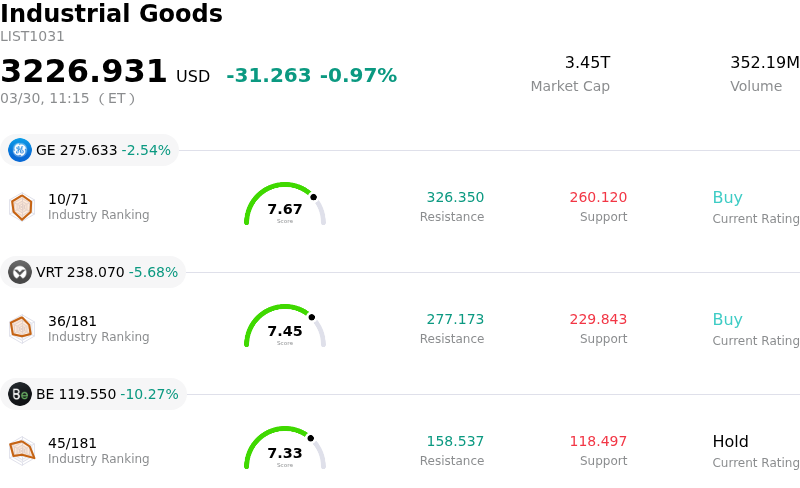
Caterpillar Inc (CAT) moved down by 3.82%. The Industrial Goods sector is down by 0.97%. The company underperformed the industry. Top 3 stocks by turnover in the sector: General Electric Co (GE) down 2.54%; Vertiv Holdings Co (VRT) down 5.68%; Bloom Energy Corp (BE) down 10.27%.
What is driving Caterpillar Inc (CAT)’s stock price down today?
Caterpillar's stock experienced a notable downward movement today amidst significant intraday volatility, largely influenced by a confluence of macroeconomic concerns and company-specific pressures. A primary factor appears to be a recalibration of geopolitical risk premiums, specifically related to the Iranian conflict that began in March 2026. This conflict has fueled concerns over escalating energy costs and potential supply chain disruptions, impacting the global mining and industrial sectors where Caterpillar is a key player. Such broader market uncertainties have contributed to a risk-off sentiment, leading to profit-taking in previously strong-performing industrial stocks.
Adding to these broader market headwinds, Caterpillar faces specific financial challenges from increased tariff costs. The company recently projected a substantial $2.6 billion impact from tariffs in 2026, with a significant portion expected in the first quarter. This increased cost estimate, which is higher than the previous year, is putting pressure on profit margins across its segments. Furthermore, news of Caterpillar countersuing Bobcat for alleged industrial espionage and Washington state's divestment of Caterpillar bonds due to activist pressure have likely contributed to negative sentiment surrounding the company. The stock's premium valuation, trading significantly above its historical average, also suggests that it may be more sensitive to negative news and broader market pullbacks.
These immediate pressures are impacting the stock despite a generally strong underlying business outlook. Caterpillar recently reported record full-year sales and a robust order backlog extending into 2026, driven significantly by demand for power generation equipment for AI data center infrastructure. Analysts have largely maintained positive ratings and raised price targets, citing the company's strong market position and its pivotal role in critical infrastructure development and the ongoing industrial sector rebound. However, these longer-term positive fundamentals appear to be temporarily overshadowed by current geopolitical anxieties and specific financial risks.
Technical Analysis of Caterpillar Inc (CAT)
Technically, Caterpillar Inc (CAT) shows a MACD (12,26,9) value of [-2.07], indicating a sell signal. The RSI at 46.07 suggests neutral condition and the Williams %R at -57.28 suggests oversold condition. Please monitor closely.
Fundamental Analysis of Caterpillar Inc (CAT)
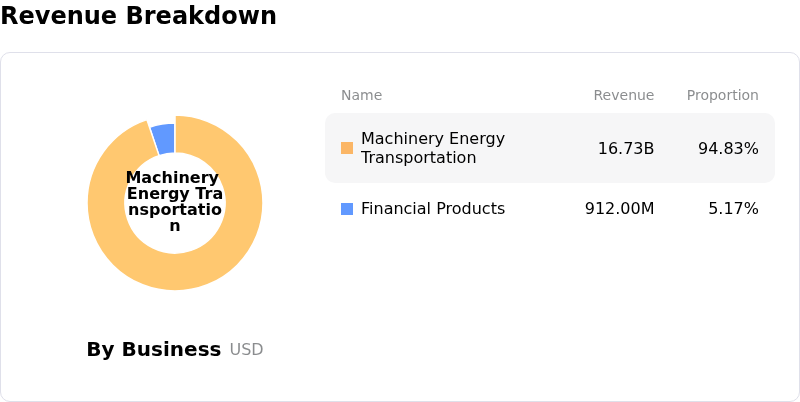
Caterpillar Inc (CAT) is in the Industrial Goods industry. Its latest annual revenue is $67.59B, ranking 1 in the industry. The net profit is $8.88B, ranking 1 in the industry. Company Profile
Over the past month, multiple analysts have rated the company as Buy, with an average price target of $721.98, a high of $878.00, and a low of $425.00.
More details about Caterpillar Inc (CAT)
Company Specific Risks:
- UBS has downgraded Caterpillar's stock to a "Sell" rating with a significantly reduced price target of $243 from $385, reflecting concerns over potential earnings challenges and broader macroeconomic headwinds not fully priced in, with their 2026 EPS forecast being 28% below consensus.
- Caterpillar anticipates a substantial financial headwind of $2.6 billion from tariffs in 2026, including an estimated $800 million impact in the first quarter, which is expected to pressure profit margins across its segments.
- The company is involved in ongoing patent infringement litigation initiated by Bobcat Company concerning key technologies within compact equipment, posing potential legal and financial liabilities.
- Analysts express concerns regarding Caterpillar's current stock valuation, noting its price-to-earnings ratio significantly exceeds historical averages and industry benchmarks, indicating a potential for market correction if unrealistic growth assumptions are not met.
Find out more
Comments