As the AI industry moves from the training stage to the era of inference and Agentic AI, CPUs, which were once masked by the light of GPUs, are re-emerging as the focus of the market.
The latest report from UBS pointed out that Agentic AI will drive server CPU demand significantly beyond the traditional cycle. Under this trend,AMD continues to expand its server market share with strong product competitiveness, while ARM architecture is favored by cloud vendors and AI infrastructure vendors because of its energy efficiency advantages。 At the same time, the latest report of Bank of America believes that the expansion of CPU demand will drive the simultaneous growth of advanced process and advanced packaging demand, thus benefiting TSMC, ASE and other manufacturing leaders.
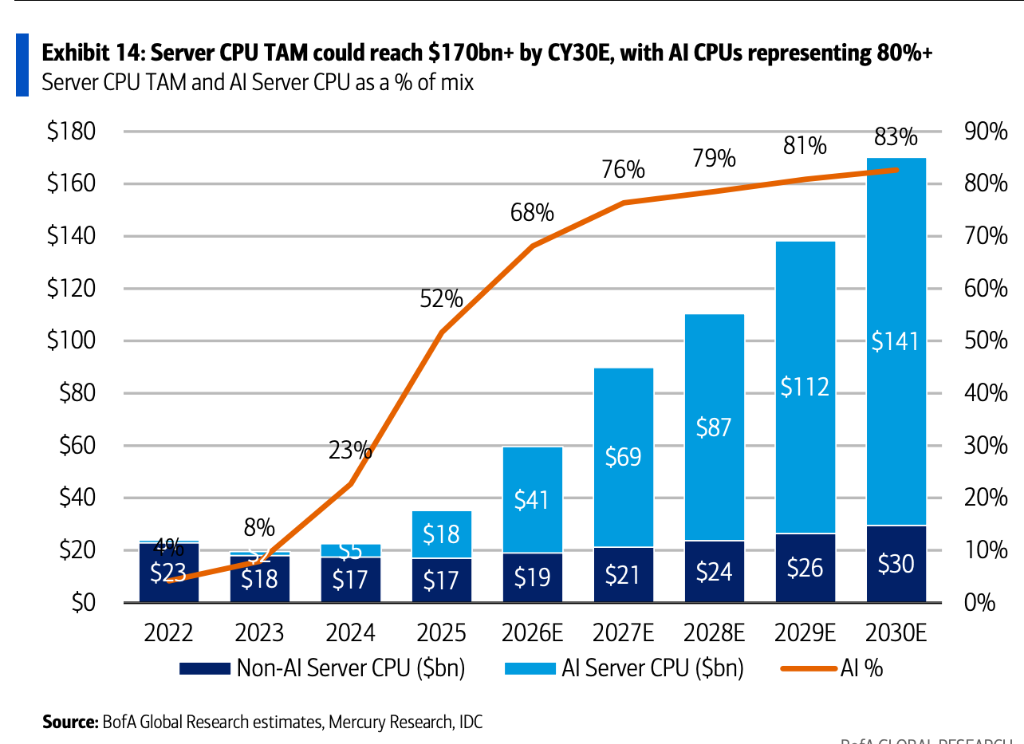
The common basis of the judgment of the two institutions is that AI infrastructure is shifting from simply pursuing the scale of computing power to building a more complete computing system. The GPU is still responsible for the core training and inference tasks,However, the role of CPU in data management, Agent execution, multi-model collaboration and system scheduling is becoming more and more critical.Bank of America expects the global server CPU market to grow to more than $170 billion by 2030.
As AMD and ARM continue to expand their market share, more high-end CPU orders will flow to advanced process suppliers such as TSMC, and the popularization and complexity of Chiplet architecture is also expected to benefit advanced packaging manufacturers such as ASE.
CPUs are back at the core as Agentic AI rises
In the past few years, the construction of AI infrastructure has mainly focused on GPU, and CPU has taken on more auxiliary roles such as data scheduling, storage management and task coordination.As AI applications gradually shift from training to reasoning, and further evolve to Agentic AI, the importance of CPU is rapidly increasing.
In the Agentic AI scenario, models need to plan tasks, call tools, access databases, manage states, and execute complex workflows. This kind of work does not rely entirely on matrix computation, but includes a large number of sequential execution, low latency, and high I/O requirement tasks, which is more suitable for CPU processing.
The CPU is being upgraded from the traditional "host processor" to the "control hub" of the AI system. If the CPU fails to complete data scheduling, memory management and task coordination in time, even if the GPU performance is stronger, the utilization rate may decrease.
Based on this trend, the global server CPU market is expected to enter a new growth cycle, with the market size exceeding US$170 billion by 2030, representing a nearly five-fold increase from approximately US$35 billion in 2025.
Standalone AI server market points to x86, AMD takes the lead
Against the background of CPU demand explosion, UBS is further optimistic about AMD's long-term growth space.
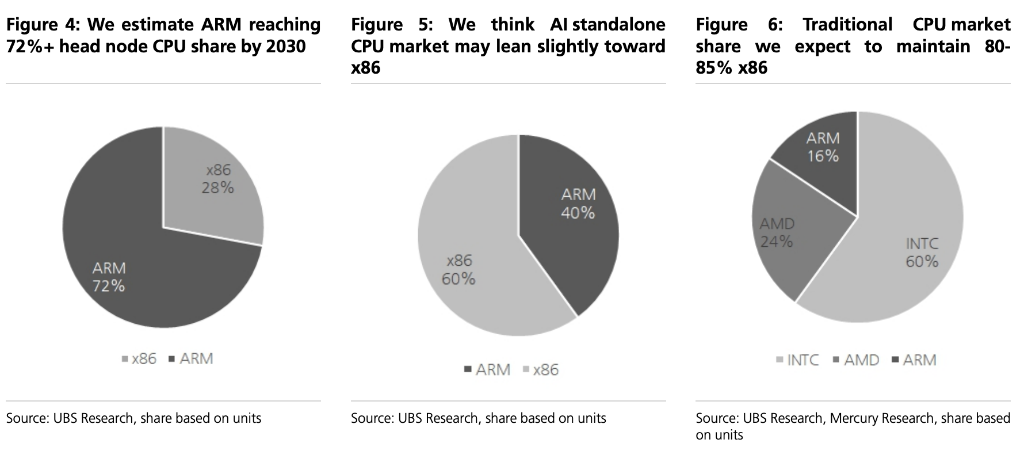
The agency believes that,Standalone Agentic AI servers are on the rise rapidly, and this type of application focuses more on core count and multi-threading performance, which is precisely where AMD has the advantage。 According to the latest calculation of UBS, in the independent AI server market, the market share of x86 architecture and ARM architecture will reach 60% and 40% respectively in the future.AMD is expected to get the vast majority of x86 incremental demand。
Based on higher market share expectations, UBS raised AMD's 2027 server CPU revenue forecast to $23 billion from $21 billion and 2028 forecast to $29 billion from $27 billion, and expects server CPU revenue to reach $50 billion in 2030, up from the previous forecast of $41 billion.
Correspondingly, UBS raised the AMD price target significantly from $455 to $670.
Sword points to 70% head node share, ARM ecosystem accelerates expansion
In addition to AMD, ARM is also a key bullish direction for UBS.
The report pointed out that AI infrastructure will gradually form two types of CPU architectures in the future: one is Head Node CPU connected to GPU, emphasizing low latency and high energy efficiency; The other category is the standalone Agentic AI server, which emphasizes the number of cores and throughput.
UBS believes that in the former market, ARM architecture has obvious advantages. NVIDIA Grace, Vera, and products like Google Axion and AWS Graviton are expanding rapidly. The agency expects,ARM architecture is expected to capture about 70% of the Head Node CPU market by 2030 and gain close to 50% of the overall server CPU revenue share.
UBS raised its ARM price target to $470 from $260 based on an optimistic judgment on the outlook for AI CPUs.
TSMC and ASE ushered in a new cycle of expansion
The surge in CPU demand is becoming the new growth pole of the semiconductor industry after GPU. Bank of America pointed out,This trend is not only beneficial to chip design enterprises, but also directly transmitted to manufacturing and packaging and testing links.
According to Bank of America, the global server CPU-related semiconductor manufacturing market is expected to expand from US$15 billion in 2025 to US$49 billion in 2028. Among them, the proportion of outsourced production will increase from 52% to 71%, reflecting the continuous strengthening of the core position of pure wafer foundries represented by TSMC in the field of high-end CPUs.
The scarcity of advanced production capacity, superimposed on multi-customer and multi-architecture parallel volume, makes the foundry link the most certain beneficiary node in this round of upward boom.
At the same time, the demand for AI CPU for Chiplet heterogeneous integration, CoWoS advanced packaging and system-level testing continues to rise, which is driving the rapid expansion of the back-end packaging and testing market.Bank of America expects that the market size of server CPU-related packaging and testing will increase from US$1.9 billion in 2025 to US$9.6 billion in 2028, accounting for 11% to 24% of the advanced packaging market.
The upgrading of the packaging value chain not only increases the packaging value of a single chip, but also prolongs the operation time of subsequent processes such as testing, which brings opportunities for both volume and price increase to packaging and testing leaders.
Based on the above supply and demand pattern judgment,Bank of America simultaneously raised the valuation forecast of supply chain leaders such as TSMC and ASE, believing that advanced processes and advanced packaging are still the most barrier links in the industrial chain。 In the new round of computing architecture transformation driven by Agentic AI, the trend of parallel evolution of CPU and GPU is becoming increasingly clear, and foundry and packaging and testing manufacturers with technological leadership and scale effect are expected to continue to benefit from the double dividend of customer diversification and single chip value enhancement in this cycle.
Comments