NVIDIAHand over a strong quarterly report,Goldman SachsIt believes that three catalysts will drive the stock price to continue to outperform the market.
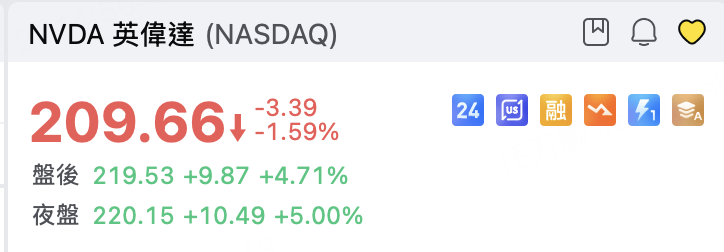
Nvidia reported second-quarter revenue of $96.2 billion, beating Wall Street estimates. Management immediately gave a full-year outlook of 70% revenue growth in the calendar year 2027, far exceeding Goldman's previous estimate of 55% and the consensus market expectation of 44%. Boosted by this, Nvidia shares rose about 4% after hours.
According to the news of Chasing the Wind Trading Desk, Goldman Sachs reiterated its buy rating on Nvidia in the latest research report.And raised its 12-month price target to $300 from $285, implied potential total return room of about 38% from the current share price.According to a team led by Goldman Sachs analyst James Schneider,The 2027 revenue guidance is in line with the most optimistic buyer expectations, while the clarity of gross profit margin outlook and management's disclosure of financial commitments to customers will together provide more solid support for the stock valuation.
Quarterly report exceeded expectations in all aspects, and data center business led the way
Nvidia's overall second-quarter results surpassed Goldman Sachs and market expectations. The revenue was $96.2 billion, higher than Goldman Sachs' estimate of $93.1 billion and the market estimate of $92.4 billion, a year-on-year increase of 106%. Data center revenue was $89 billion, higher than Goldman's estimate of $86.5 billion; Edge computing revenue was $7.2 billion, which also exceeded Goldman Sachs and the market expectation of $6.5 billion.
Profitability was equally solid. Non-GAAP gross margin was 75.0%, which was in line with Goldman Sachs forecast and slightly higher than market expectations of 74.8%; Operating profit margin was 66.5%, slightly exceeding Goldman Sachs and market expectations; Non-GAAP earnings of $2.22 per share topped Goldman's estimate of $2.12 and market expectations of $2.09.
In terms of inventory, inventory rose to $31.6 billion in the second quarter, up 22% quarter-over-quarter, and the inventory days were 120 days, up four days quarter-over-quarter, as the company stockpiled ahead of time for mass production shipments of Rubin products in the third quarter. Accounts receivable increased by 55% month-on-month to US$63.1 billion, and the accounting period was extended to 60 days, reflecting the extension of payment terms of some major customers' purchase agreements.
2027 guidance greatly exceeds expectations, Rubin contributes significantly to heavy volume
The most market-impactful information for the quarter comes from management's outlook for fiscal year 2027 (calendar year 2027). Nvidia expects revenue to grow by 70% in the fiscal year, far exceeding Goldman's previous estimate of 55% and the market consensus estimate of 44%. At the same time, the management pointed out that if it is not constrained by supply, the company's potential demand growth rate will actually exceed 100%, and the supply bottleneck will continue to restrict the actual shipment rhythm in the next 18 months.
Goldman Sachs calculates that,This guidance increase means that Nvidia's previous target of cumulative revenue of $1 trillion from 2025 to 2027 for Blackwell, Blackwell Ultra and Rubin products has increased by about $250 billion again.
The heavy volume of Rubin products is an important driving force for this guidance upgrade. Management expects Rubin product shipments to contribute about 20% of forecast revenue in the third quarter. Goldman Sachs believes,The above demand outlook reflects that the procurement demand of emerging customer groups such as AI laboratories, emerging cloud service providers (neoclouds) and sovereign customers is accelerating, and is not limited to hyperscale cloud vendors.
In addition, NVIDIA Vera CPU standalone racks are also showing strong demand, partially driven by Agent-style AI applications. The company maintains its forecast of $20 billion in CPU-related revenue for the 2026 calendar year, and expects CPU shipment growth to exceed 100% in 2027.
Gross profit margin outlook is clear, Goldman Sachs regards it as a valuation "clearance event"
Gross profit margin trend was one of the most concerned topics in the market ahead of this quarter. Nvidia gave third-quarter non-GAAP gross profit margin guidance of 74.0%, which was lower than Goldman Sachs and the market expectation of about 74.9%. The main pressure came from the rising memory cost of HBM and the climbing of Rubin products.
Management further noted that gross margin will bottom out in the fourth quarter with a range of 71% to 72% before recovering and stabilizing at 72% to 73% in fiscal 2027. This level is lower than the market's previous estimate of 75.1% for fiscal 2027, but Goldman believes the guidance is broadly in line with market expectations and may even be higher than some of the bearish expectations.
Goldman Sachs made it clear in the research report that,In view of the previous market's high concern about gross profit margin, the implementation of this guidance is expected to eliminate the core uncertainty and become a "clearing event" of stock price.At the same time, the company said that it had taken pricing action to partially hedge the cost pressure brought by the price increase of HBM memory.
Transparency in financial commitments, return on capital commitments reaffirmed
Nvidia also made detailed disclosures on its various financial commitments on the client side this time. Management disclosed that the company's overall financial commitments totaled US$366 billion, covering supply and capacity commitments (US$279 billion, mainly memory), cloud service agreements (US$29 billion), data center leases (US$25 billion), equity investments (US$25 billion) and capital expenditures (US$5 billion). In addition, data center land, power and infrastructure guarantees related to SoftBank Energy and AI Cloud amounted to an additional US$108.5 billion.
At the same time, Nvidia disclosed a $500 billion financing platform announced with financial partners on August 10, aiming to support the infrastructure construction of AI laboratories, enterprises and AI cloud vendors at competitive interest rates. Nvidia can provide a residual value support mechanism of up to 25% for specific projects, evaluated on a project-by-project basis.
Goldman Sachs believes that the above disclosure will help investors more clearly assess the company's financial risk exposure, and the management reiterates that it will give back more than 50% of the excess free cash flow to shareholders, which can be realized sustainably even in downside scenarios.
Valuation & Ratings: Raised Price Target to $300
Based on the performance beating expectations and the upward guidance, Goldman Sachs raised Nvidia's 2027 and 2028 EPS estimates to $16.70 and $23.00, respectively, with an average increase of about 9%, mainly reflecting a higher revenue base, partially offset by a downward revision of gross profit margin.
The price target is raised to $300 from $285, corresponding to a 30x P/E ratio (multiple unchanged) multiplied by the normalized EPS estimate of $10.00 (up from the previous $9.50). Goldman Sachs also gave a bull scenario valuation of $424 (35x P/E, EPS $12.10) and a bear scenario of $175 (25x P/E, EPS $7.00).
Goldman noted that Nvidia's median third-quarter revenue guidance of $108 billion was lower than Goldman's forecast of $110.7 billion but higher than market expectations of $104.6 billion; Non-GAAP EPS implied value of $2.43, above market estimates of $2.32. Goldman Sachs believes that the above guidance also shows that the overall AI infrastructure spending environment is stable, and it is very important for Broadcom,AMDMarvell, ARM andIntelThe semiconductor covering target constitutes a positive signal.
Comments