Over the past two weeks, while Trump's erratic behavior has somewhat subsided, most assets have experienced varying degrees of rebounds and corrections as previously anticipated. Some faster-moving products have essentially reached their target levels, making it an appropriate time to consider securing profits. Other lagging assets shouldn't automatically be viewed as having catch-up potential, as when market leaders begin to weaken, followers typically face pressure to follow suit.
Cryptocurrency Market Analysis
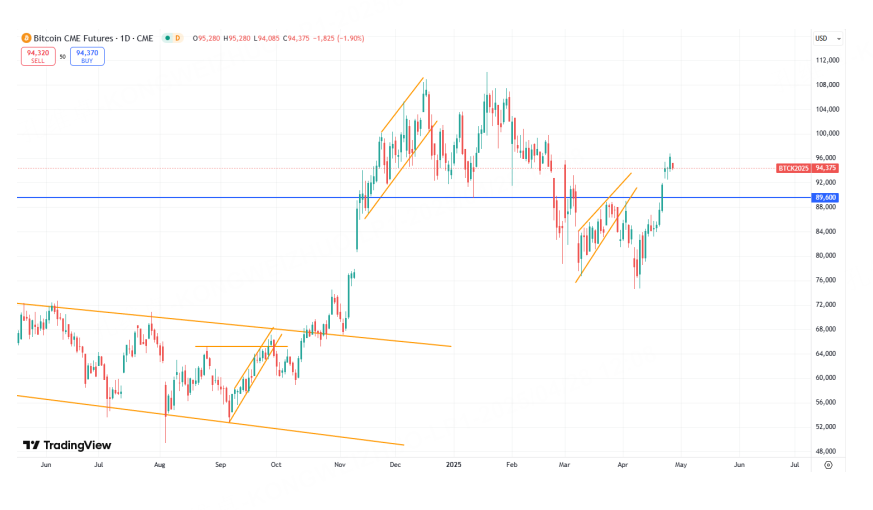
Let's first examine the cryptocurrency market, which showed resilience during the decline and led the rebound, with Bitcoin (BTC) as our primary benchmark. The price approached $97,000 over the weekend, representing approximately a $23,000 (30%) rebound from its low point. Although the long-term outlook suggests BTC's ultimate destination may still be around $120,000-$130,000, this current upward movement is merely a rebound rather than a reversal1. With the approach of previously identified dense resistance zones, even if there's still room for a further push higher, the upside potential is extremely limited, making this an ideal position to close long positions. Other cryptocurrencies such as Ethereum (ETH) and various altcoins may present short-selling opportunities1.
After this rebound concludes, the market will likely experience a significant downward exploration, needing to test previous lows to form a large double-bottom structure1. Only then will the upward trend restart and move toward its ultimate target. Subsequently, we can expect an even larger pullback or reversal, and a 50% drop shouldn't come as a surprise1. Weaker assets like ETH have the potential to return to their 2022 lows (around $880).
Oil Market Outlook
Comparatively, oil, another closely watched asset, is also approaching the end of its rebound, but its technical structure appears significantly weaker than Bitcoin's1. The current oil price rebound more closely resembles a confirmation retracement following a breakdown below previous key support levels. Unless prices unexpectedly climb above the $72.28 high, the medium-term downtrend will likely continue1. Oil is one of the commodities that the Trump administration traditionally prefers to "manage," but the strategy invariably mirrors that applied to US stock indices-suppression first, followed by appreciation. Oil prices may need to create substantial pressure on the shale industry around the $45 level before experiencing a meaningful trend reversal to the upside1.
US Stock Indices
Regarding US stock indices, since they were discussed extensively in the previous two weeks, there's no need for repetition here1. Overall, stock indices performed well last week and may still have some upside potential, though likely limited to approximately 3-5%1. From a trading perspective, vigilance toward news developments remains essential, as an early end to the rebound correction wouldn't be surprising. The market will likely need to establish new lows before genuinely stabilizing1.
Gold Market Perspective
Finally, let's address gold, a topic of interest for many. The reason for not discussing gold recently is primarily due to missing entry opportunities, leaving only patient observation as an option1. From a trend perspective, while gold prices have undergone some correction, there are no signals indicating a major reversal. As long as the $2,970 support level remains intact, most market participants will likely continue to buy on dips1. Historical patterns suggest that significant market tops rarely form quickly, so even if we are witnessing a top, we should expect fluctuating market conditions. Currently, the $3,070-$3,200 range presents a viable trading opportunity, with the ability to establish new highs being crucial for trend continuation1.
Strategic Approach to Gold
From a strategic standpoint, rapid sharp declines offer attractive buying opportunities, while short-selling may require greater caution1. Regardless of approach, gold's volatility this year significantly exceeds that of typical years, necessitating more careful leverage and risk management. The prudent approach permits small profits, break-even results, or minor losses, but aggressive positions that could lead to substantial losses should be strictly avoided1.
Conclusion
As we navigate these market conditions, it's crucial to recognize that many assets have approached their rebound targets and may be preparing for trend reversals. The cryptocurrency market appears to have the strongest technical structure despite nearing resistance levels, while oil displays comparative weakness1. US indices have limited remaining upside, and gold continues its volatile but generally bullish pattern. For traders and investors alike, this environment calls for increased vigilance, appropriate position sizing, and a readiness to adapt to sudden market shifts as we approach potential inflection points across multiple asset classes
$E-mini Nasdaq 100 - main 2506(NQmain)$ $E-mini Dow Jones - main 2506(YMmain)$ $Gold - main 2506(GCmain)$ $Silver - main 2507(SImain)$ $WTI Crude Oil - main 2506(CLmain)$
Comments