The Robotaxi concept has heated up further in the last couple of days, with $Uber(UBER)$ announcing the expansion of its partnership with Waymo to parts of Atlanta, following the launch of $Tesla Motors(TSLA)$ Robotaxi
UBER users will be able to book $Alphabet(GOOG)$ 's Waymo's self-driving cars for ride-hailing services and local deliveries through the UBER and UBER Delivery apps.
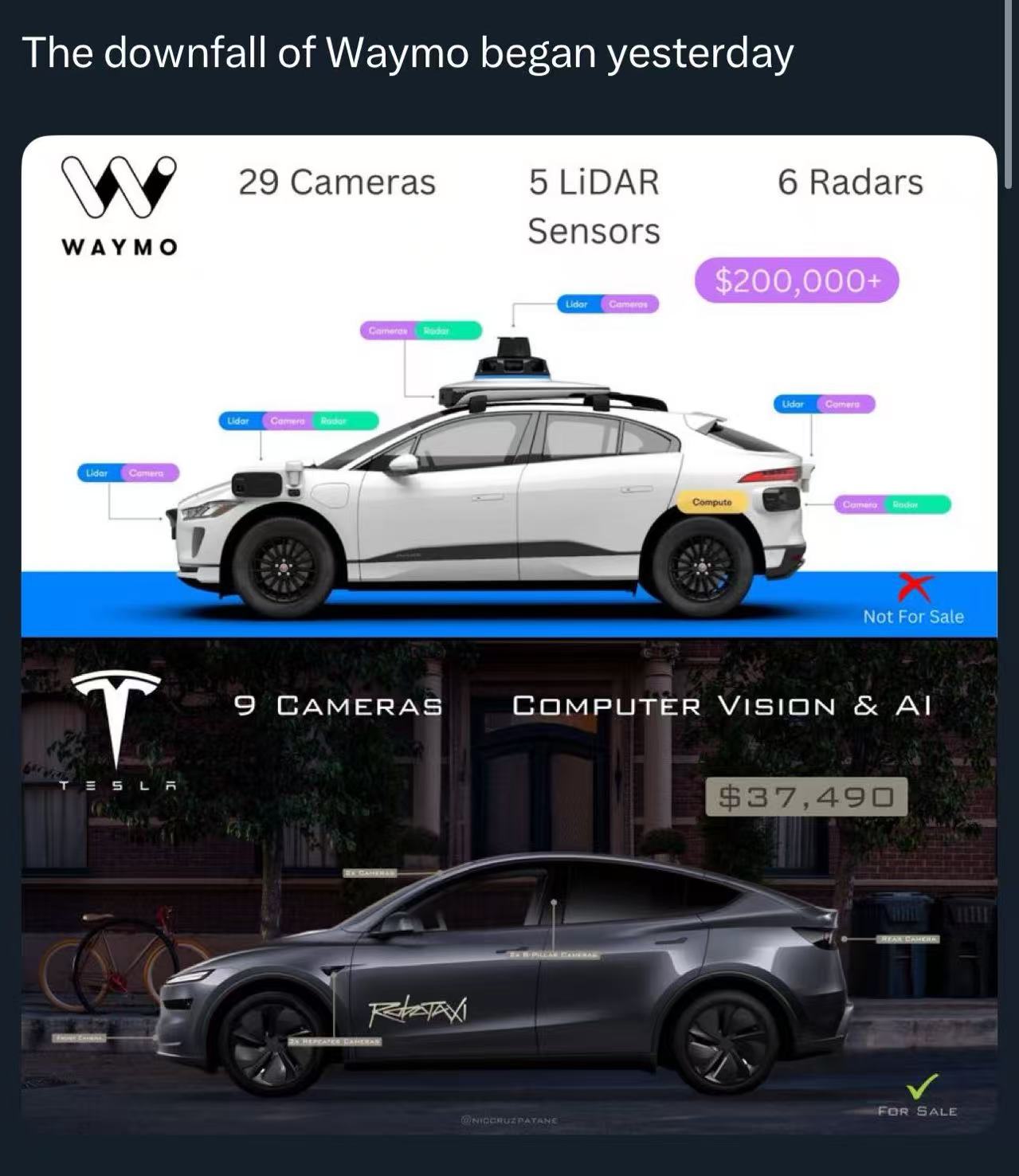
Comparison of Tesla Robotaxi and Waymo
Waymo's high single-vehicle cost ($150,000-$200,000) stems primarily from sophisticated hardware inputs such as LIDAR, city-level map deployment, and safety redundancy design.Despite continuous cost reduction through technology iteration (e.g. LIDAR cost reduced to 1/10), it is still significantly higher than its competitors in the short term.Its commercialization process relies on scale operation and supply chain optimization, and future cooperation with Toyota may become the key to cost breakthrough.
Compared with Robotaxi's $30,000-$50,000, this cost may become an obstacle to scale citation.
How exactly is Waymo's cost of a single vehicle calculated?
There are differences due to technology iteration and calculation caliber, but according to the latest information, the core data and composition are as follows:
Current total cost of a single vehicle
Overall range: about $150,000 - $200,000
Specific case: vehicles burned in the 2025 Los Angeles protests cost about $160,000 (roughly over $700,000) for a single vehicle.
Cost Composition Analysis
Hardware Costs
Sensor system: includes LiDAR, cameras, millimeter wave radar, and audio detection system.The sixth-generation Waymo Driver features 16 cameras, five LiDARs, six radars, and an external audio array.
LIDAR COST REDUCTION: Early LIDARs cost up to $75,000 per unit, reduced to ~$7,500 through in-house research.
Total hardware cost: about $140,000 (accounting for most of the vehicle cost).
Other Operating Costs
Vehicle dep reciation: approximately $35,000 per year for a useful life of about 4 years.
Maintenance costs: about US$2,000 per year on average (higher than an average vehicle).
Energy and insurance: charging costs are based on local electricity prices, and insurance costs are about 10% of the total transaction amount.
Remote manpower support: each vehicle needs to be monitored in the background, and the current manpower allocation is about 1 operator supporting 5 vehicles.
Impact of technology route on cost
Waymo adopts multi-sensor fusion + high-precision map solution, which ensures safety redundancy but pushes up costs:
Map deployment: need to rebuild high-precision maps for each new city entry, costly and slow to expand.
Compare to Tesla: Tesla's pure vision solution has a target cost of only $15,000 (1/6th of Waymo's), but has not yet been validated at scale.
Cost Optimization Trends
Technology iteration: the cost of the fifth-generation system is 50% lower than that of the fourth-generation, and the degree of hardware integration has been improved.
Collaboration to reduce costs: Collaboration with Toyota to develop models for the personal consumption market, leveraging the supply chain advantages of traditional car companies to further compress costs.
Scale effect: fleet size exceeds 1,500 vehicles and is planned to expand to 15,000 vehicles by 2030, which is expected to reduce costs in the long run.
Comments