


They say that “cash is king”. GameStop's free cash flow is a key metric that speaks to the company's long-term success.
Business fundamentals are not necessarily at the core of retail investors' thesis for investing in GameStop stock. Rather, beating short-sellers at their own game seems to be a key factor — part of why GME is considered a meme stock.
However, when considering a long-term investment in any stock, fundamentals should matter. Here is why GameStop investors might want to think about cash and cash flow as key metrics to track.
‘Cash Is King’
In fundamental analysis, free cash flow (FCF) is potentially the most important metric that should be scrutinized when analyzing a company.
It is through cash flow that a company can finance growth and cash returns to shareholders, whether through dividends or share buybacks. A strong cash pipeline also allows for acquisitions that fuel inorganic growth, and improves the balance sheet by reducing debt.
To many, cash is a matter of ultimate success or failure. Growth companies and their stocks can “reach escape velocity” when they become profitable and cash flow-positive, allowing them to thrive without the need for further debt or equity investments.
GME's Free Cash Flow Per Share
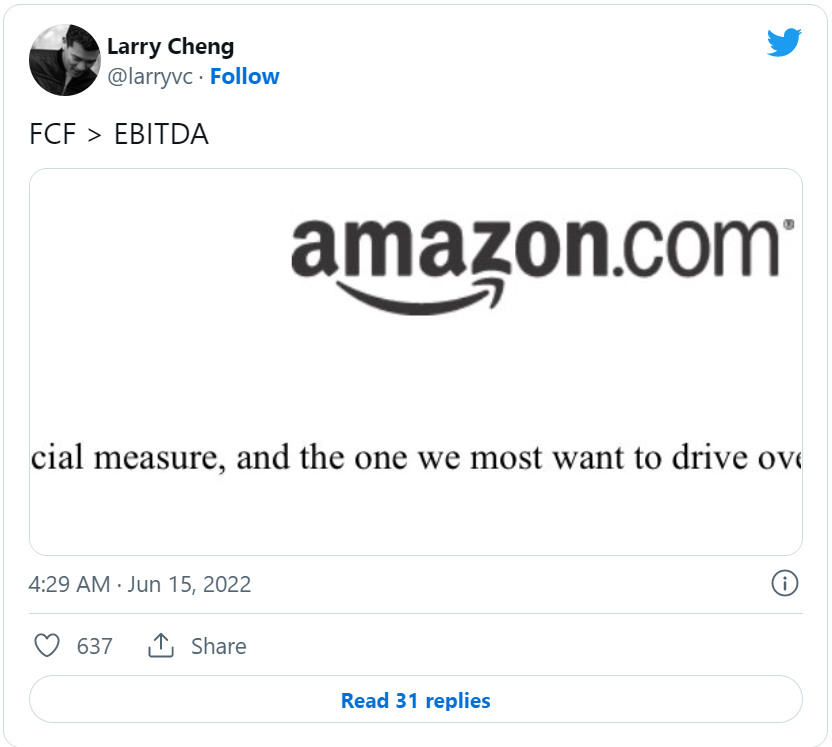
GameStop director and company board member Larry Cheng recently tweeted that free cash flow (FCF) is more important than earnings before interest, taxes, depreciation, and amortization (EBITDA).
In the tweet, Cheng brought up a statement from Amazon to its shareholders indicating that free cash flow per share is the most important metric to watch.
EBITDA, a non-GAAP metric associated with the income statement, has some shortcomings in determining the financial health of a company. Most importantly, it does not provide visibility into a company’s liquidity and balance sheet robustness, as accrual accounting can cloud the company’s ability to produce cold, hard cash.
Currently, GameStop has a total cash position of over $1 billion, which is a considerable amount compared to the worst of the COVID-19 crisis (see below). GameStop has been able to protect its cash balance by issuing a whopping $1.67 billion in equity last year.
But cash raised through share issuance is quite different from cash produced by operations. Data from the end of April 2022 shows that FCF per share has been negative $10.47, the lowest since 2010.
GameStop has been using $300 million in cash to support operations each quarter. If not addressed, this could put the company’s balance sheet in a delicate position. At the current spending pace, and all else held equal, GameStop could run out of cash next year.
GameStop's Cash Flow Situation
Larry Cheng's tweet suggests that GameStop's management team understands that free cash flow is a priority. For now, however, the company is looking to stay afloat through further equity financing.
Recently, during GameStop's annual shareholder's meeting, an increase of 8 million shares was approved as part of the 2022 Incentive Plan. GameStop's management had already communicated that since last year they would issue more equity strategically. This could be part of a turnaround plan for the company's balance sheet if it is able to sell shares at a high price, as it did in 2021.
Clearly, there is work to be done. GameStop's most recent quarterly results were short of impressive. The better news is that many of the company’s difficulties in producing operating cash flow seem related to supply chain disruptions, an external issue that could improve and at least stabilize the cash burn later this year or in 2023.
In our opinion, shareholders should be always looking for clarity from the management team on how GameStop can make quick progress on cash flow.