


What should we do if Meituan collapses? Leading strategies to help you
Amid the fierce takeaway and instant retail price war, Meituan handed over its report card in the second quarter.
The financial statements show,$Meituan-W (03690) $In the second quarter of this year, revenue was 91.84 billion yuan, a year-on-year increase of 11.7%; However, the operating profit in the second quarter plummeted 98% to 230 million yuan, and the operating profit margin fell from 13.7% to 0.2%; The adjusted net profit in the second quarter was RMB 1.49 billion, a year-on-year decrease of 89% compared with RMB 13.606 billion in the same period last year, and far lower than the estimated RMB 9.85 billion.
When Hong Kong stocks opened this morning, Meituan opened 9.72% lower at HK $105, with a turnover of HK $1.656 billion.
"Meituan has grown up in competition. The current competition in the food delivery market continues to intensify, and we will continue to defend our market position." Meituan CEO Wang Xing said at the financial conference last night that he resolutely opposes the current involutional competitive situation, and the regulatory authorities do not want this kind of competition in the market.
He said at the above-mentioned performance meeting that this is not the first time Meituan has faced such fierce competition. In the past years of development, Meituan has continued to grow and consolidate its leading position in the competition. Whether in the past or now, Meituan has always focused on doing the right thing, that is, ensuring high-quality supply, stable performance of contracts, reasonable prices, and creating a good experience for users.
Meituan's plunge has also affected other Chinese concept stocks.$Alibaba (BABA) $、$JD $Internet companies such as Internet companies have also plummeted accordingly. For investors with large holdings, they can consider adopting strategies to protect their holdings at this time.
What exactly is a domain strategy?
To protect the downside risk of stocks, there is a strategy of buying put options (Protective Put), and to reduce the cost of holding stocks, you can sell Covered Call options (Covered Call). To do both, Collar, a new strategy, was born.
The operation method of collar options is to buy a lot of out-of-the-money put options as insurance on the premise of holding stocks, and at the same time sell a out-of-the-money call option to pay the cost of insurance. This is equivalent to putting a Collar on the stock, within which the returns of the stock are locked, hence the name of the Collar option. Collar options are actually a combination of Protective Put and Covered Call, which limits the risk of downside at the price of removing some of the possibility of upside profits.
Collar options can be used when traders have bullish positions in the relevant market and want to protect their positions from downward market shocks. When the full cost of the put option is covered by the sale of the call option, this is called a zero-cost strategy.
KWEB Frontier Option Strategy Case
Assume that the investor holds 100 shares at a current price of $37.47$China Overseas Internet ETF-KraneShares (KWEB) $Investors are not sure how prices will change in the near future and want to buy insurance for their holdings. You can use the collar strategy.
In the first step, investors can sell a bullish option with a trip price of $38 and an expiration date of October 3rd at a price of $1.19, earning $119.
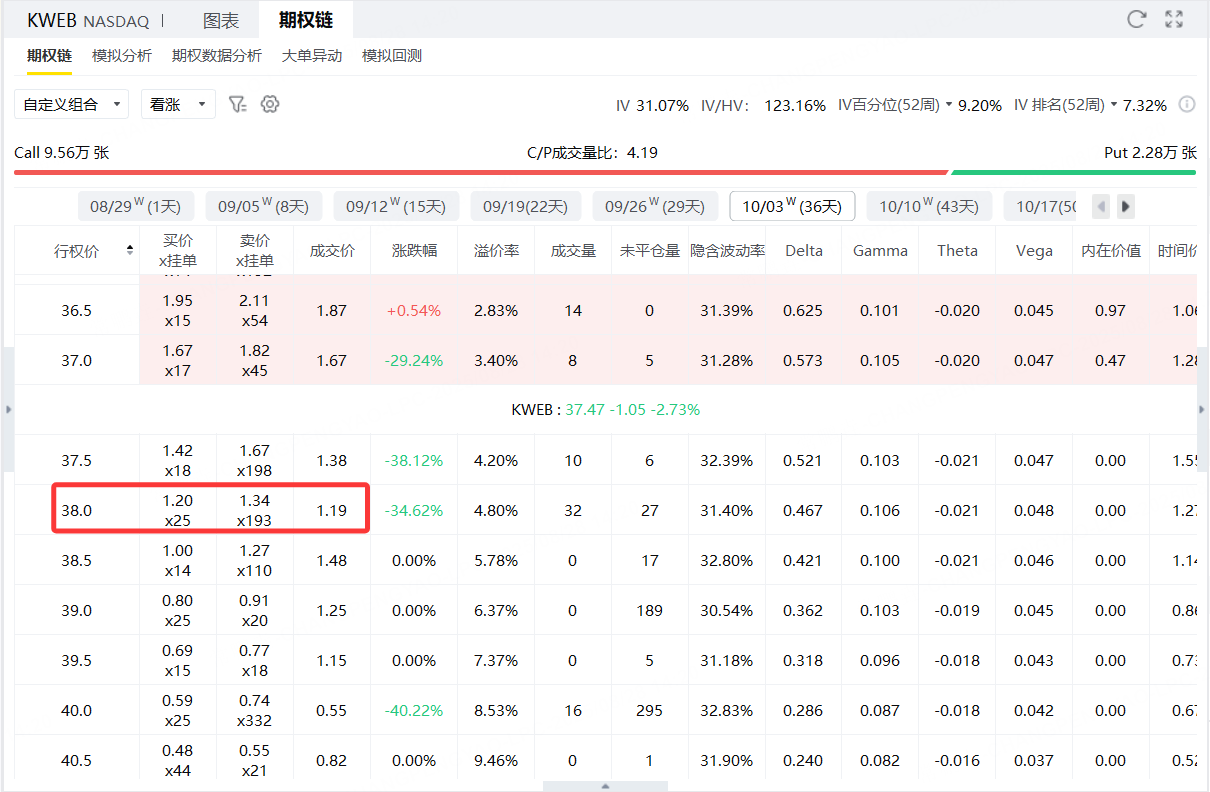
In the second step, you can also buy a put option with an exercise price of $36.5 and an expiration date of November 8th at a price of $36.50, which costs $88.

The income and expenses of the two options mostly offset each other, and the total net income was $31, so the investor established a protective strategy at a very low cost.
The ultimate protection effect of the strategy is that if KWEB falls beyond the put exercise price of 36.5, no matter how low the price falls, the loss will be locked in.
Maximum loss = buy put option exercise price of 36.5 − underlying buy price of 37.47 + sell bullish option premium of 119 − buy put option premium of 88, or − 66 USD.
However, since investors hold 100 shares of KWEB, the book loss caused by the stock price decline is also limited to this range and will not expand further. Even if KWEB drops to $1, the maximum loss for investors is only $66.
In addition to locking in maximum losses, the lead strategy also maintains the ability of investment portfolios to generate returns. When KWEB rises to the exercise price of $38 for selling the bullish option, the portfolio gets the most returns.
From the case, it can be clearly felt that the leading strategy helps investors maintain their existing returns and prevent risks on KWEB. After the short-term volatility ends, investors can also release the colony strategy and continue to carry out directional operations such as bullish or bearish.
Disclaimer: Investing carries risk. This is not financial advice. The above content should not be regarded as an offer, recommendation, or solicitation on acquiring or disposing of any financial products, any associated discussions, comments, or posts by author or other users should not be considered as such either. It is solely for general information purpose only, which does not consider your own investment objectives, financial situations or needs. TTM assumes no responsibility or warranty for the accuracy and completeness of the information, investors should do their own research and may seek professional advice before investing.
