


NIO Strategies to Make Money Above $5.4
$NIO (NIO) $Expected to beNovember 25, 2025 (before U.S. markets open)Released Q3 financial report. The consensus EPS is-$0.22 (+29.0%) and the consensus revenue estimate is $3.14 billion (+18.0%). Over the past two years, Nio has beaten estimated EPS 38% of the time and estimated revenue 25% of the time.
Looking back at the last earnings report, revenue in the second quarter increased by 9% year-on-year to $2.653 billion, and deliveries of main vehicles increased by 25.6%. Net income was diluted EPS of minus $0.32, an improvement from minus $0.35 in the year-ago quarter, but missed analysts' estimates by $0.03.
At the 2025 Guangzhou Auto Show, Li Bin, chairman of Nio, said that the company has achieved more refined cost control through more than a year of organizational optimization, and even arranged exhibitions in advance to save "overtime pay". He revealed that because there were no new car releases and NIODay activities in the fourth quarter, and the expenses in the first three quarters have been basically paid, coupled with good sales and gross profit margins, Nio is expected to achieve profitability for the first time in this quarter. Li Bin also pointed out that the competition of smart electric vehicles has entered the "final stage", but the steady state of the industry may take ten years to form.
NIO's growth momentum mainly comes from the comprehensive coverage of its three major brands (NIO, ONVO, and FIREFLY) in the high-end, mainstream and entry-level markets. The total delivery volume in October 2025 reached 40,390 vehicles, a month-on-month increase of 16.2% and a substantial year-on-year increase of 92.6%. Among them, NIO high-end brands grew steadily, ONVO mainstream brands soared year-on-year, and FIREFLY entry-level brands maintained stable volume. As market demand accelerates and shifts to pure electric platforms, Nio is more outstanding than Ideal and BYD.
In the third quarter, Nio expects deliveries between 87,000 and 91,000 vehicles and revenue to reach $304.5 million to $3.193 billion, up ~ 16.8% to 22.5% from the same quarter in 2024.
Nio's current order backlog is at a high level, so the company has proposed a target of delivering 150,000 vehicles in Q4 2025 (a quarter-on-quarter increase of 72%), which is not radical. The high base delivery in October, the insurance coverage of more than 10,000 vehicles for three consecutive weeks, and the increase in production capacity to a maximum of 56,000 vehicles per month from October 2025 all provide a solid foundation for the substantial growth in Q4. It is estimated that Q4 deliveries are expected to reach approximately 152,000 vehicles.
On the premise that production capacity is completely ramped up, the supply chain is stable, and demand continues to be strong, Nio's annual delivery volume in 2026 is expected to reach approximately 672,000 vehicles. This scale is much higher than the 241,600 vehicles in the first 10 months of 2025, and also significantly ahead of the 222,000 vehicles in 2024, indicating that Nio is entering a high-speed heavy volume stage.
In the upcoming 2025 Q3 financial report, the market will focus on whether Nio can continue to increase the gross profit margin of vehicles. Referring to the 10.3% gross profit margin in Q2 (which remained stable despite the apparent decline in ASP), it can be seen that its scale effect is improving. If Q3 results further improve, Nio has the opportunity to approach the gross profit margin level of 16%-17% in Q4 of 2024.
Bull Put Spread
1. Strategy structure
Investors Build a On NIO (NIO)Bull Put Spread Bull Put Spread, consisting of two Put options with the same expiration date:
Sell higher strike price Put: K ₂ = 5.5, US stock premium revenue $0.14
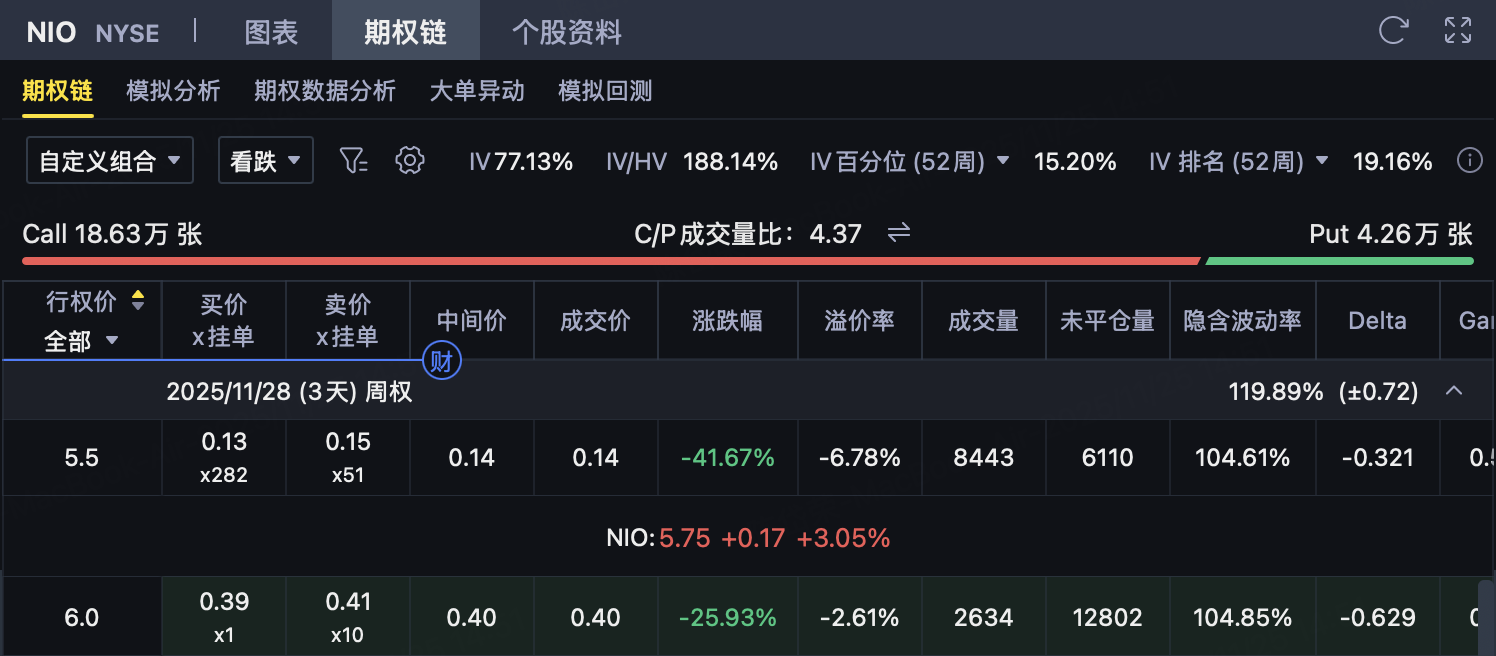
Buy lower strike price Put: K ₁ = 5, US stock premium spend $0.04
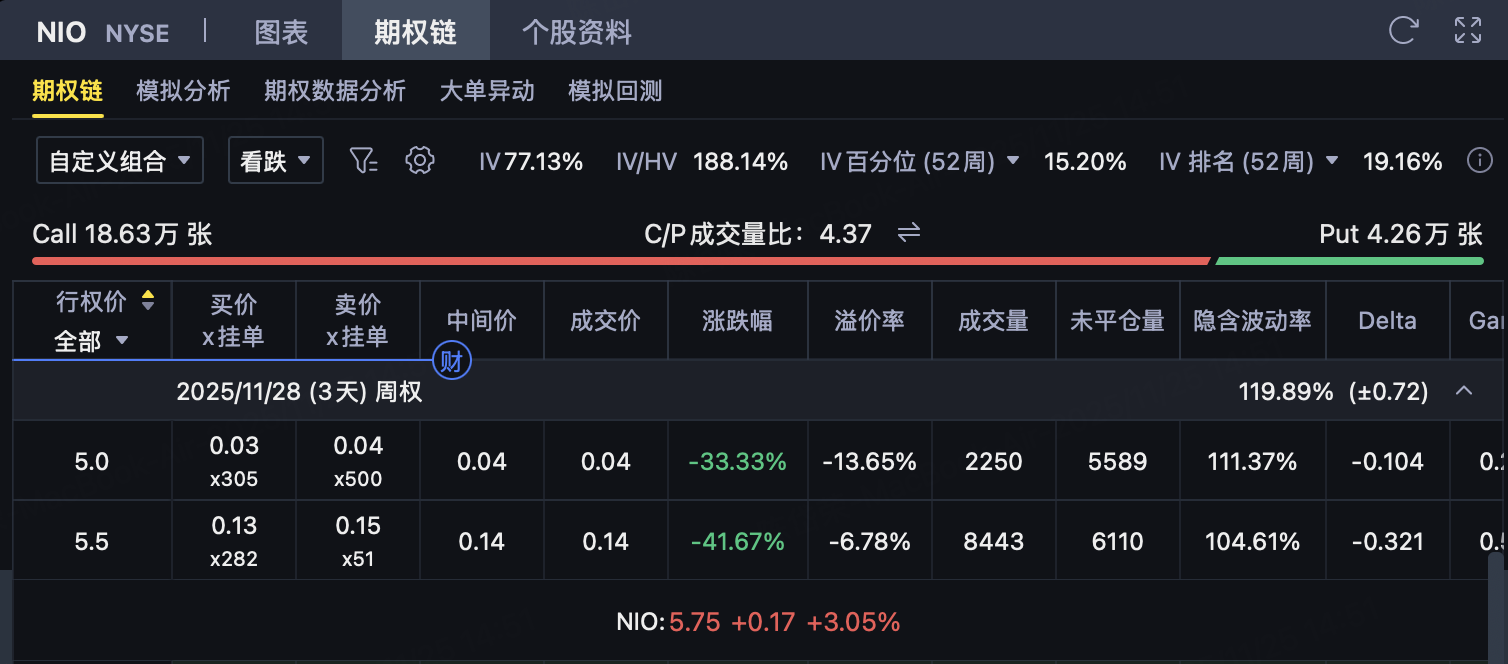
This policy is aCredit type, moreInvestors want the stock price to remain above $5.5 at expiration to maximize their gains.
Initial net income
Net premium (per share) = 0.14 − 0.04 =$0.10/share
Because 1 mouth equals 100 shares, so:
Total revenue = 0.10 × 100 =$10/contract
This is the maximum potential profit that an investor locks in when opening a position.
3. Maximum profit
When the NIO maturity price is ≥ $5.5, both Put shares become out-of-the-money and the investor retains the entire net income.
Maximum profit = $10/contract
4. Maximum loss
When the NIO expiration price is ≤ $5, both Put shares become in-the-money, and the spread is fully lost, but the net premium is retained.
Strike spread = 5.5 − 5 =US $0.5/share
Maximum loss (per share) = 0.5 − 0.10 =$0.40/Share
Total maximum loss = 0.40 × 100 =$40/contract
5. Break-even point
Break-even point calculation:
Breakeven = K ₂ − Net income = 5.5 − 0.10 =$5.40
Maturity price judgment:
≥ $5.40 → Investor Earnings
< $5.40 → Investor losses
6. Risk and return characteristics
Maximum gain: $10/contract (limited)
Maximum loss: $40/contract (limited)
Profit-loss ratio: 1: 4 (take a loss of $40 for a gain of $10)
Applicable scenario: Investors believe NIO stock will remain above $5.5
Engage and Win Options Rewards!
Share your thoughts on options trading or the market in the comments below.
10 lucky participants will each receive a free copy of the Options Handbook!
Already have one, you’ll get a USD 5 Options Voucher instead!
The Options Handbook takes you from the fundamentals to advanced strategies, helping you gradually build your own trading system. You’ll also gain insights from 10 top traders, and learn how to avoid common options trading pitfalls — making your decisions clearer.
💬 Don’t miss out, drop your thoughts and win your reward!
Disclaimer: Investing carries risk. This is not financial advice. The above content should not be regarded as an offer, recommendation, or solicitation on acquiring or disposing of any financial products, any associated discussions, comments, or posts by author or other users should not be considered as such either. It is solely for general information purpose only, which does not consider your own investment objectives, financial situations or needs. TTM assumes no responsibility or warranty for the accuracy and completeness of the information, investors should do their own research and may seek professional advice before investing.
