


How Microsoft's 27% Stake in OpenAI Redefines Strategic Partnership in the Age of AGI.
$Microsoft(MSFT)$ and OpenAI announced they are advancing their partnership to the "next phase." This aims to address previous regulatory scrutiny (such as the FTC investigation) and uncertainties, facilitate OpenAI's transition into a Public Benefit Corporation (PBC), while securing Microsoft's long-term access to AI technology.
The core lies in balancing cooperation and independent innovation to avoid excessive dependence on either party.
Key Information Summary
Partnership Structure:
OpenAI completes transition to hybrid structure: OpenAI Group PBC, overseen by a nonprofit foundation, enables more flexible revenue models while maintaining a public-interest orientation.
Microsoft continues as OpenAI's "frontier model partner," with Azure retaining exclusive API product access until OpenAI announces AGI (Artificial General Intelligence) and receives verification from an independent expert panel.
Both parties may pursue independent innovation: Microsoft may pursue AGI independently or with third parties; OpenAI may collaborate with third parties to develop products (API products remain limited to Azure, while non-API products may be deployed on any cloud).
Equity and Valuation:
Microsoft holds approximately 27% of OpenAI Group PBC's equity (on an as-converted diluted basis, including employees, investors, and foundations), valuing the company at approximately $135 billion.
Prior to this (excluding the most recent funding round), Microsoft held a 32.5% stake in OpenAI's for-profit entity. Following this restructuring, its ownership has been diluted but remains a significant influence.
OpenAI's overall valuation has reached $500 billion.
Intellectual Property (IP) and Exclusive Rights:
Microsoft's intellectual property rights have been extended to 2032, covering models, products, and post-AGI models (subject to safety safeguards).
Research IP (including model development methods) rights extend until 2030 or AGI validation (whichever comes first), but exclude model architecture, weights, inference code, fine-tuning code, and data center hardware/software (Microsoft retains these).
Microsoft relinquishes its "right of first refusal" as OpenAI's computing provider, acknowledging OpenAI's ability to pursue multi-cloud partnerships; however, Azure API exclusivity remains unchanged, and OpenAI's release of weight models must meet capability thresholds.
New: OpenAI can provide API access to U.S. government national security clients, regardless of cloud provider.
Finance
OpenAI has committed to purchasing an additional $250 billion in Azure services (incremental compute capacity), ensuring stable cloud revenue for Microsoft.
The revenue-sharing agreement extends to AGI validation, with payment periods extended (specific details undisclosed); should Microsoft develop AGI using OpenAI IP ahead of schedule, higher computational thresholds must be met.
The market views this as a positive signal of "removing uncertainty," propelling Microsoft Azure to dominate the AI cloud market and strengthening its long-term technological moat. OpenAI reported revenue of $4.3 billion in the first half of 2025 but incurred a net loss of $13.5 billion; this agreement is seen as stabilizing its financial trajectory.
The upside of Microsoft's "defensive offensive"
For Microsoft, securing core assets in the AI race while preserving OpenAI's independence helps mitigate regulatory risks and reinforces its positioning as an "AI platform" (Azure + Copilot ecosystem). This move provides short-term stock price gains and long-term assurance of hundreds of billions in revenue performance.
The influence of a 27% stake is not control but "coupling."
Although the 27% stake is not a majority, its $135 billion valuation, coupled with board representation and strategic influence, is sufficient to shape OpenAI's direction (as demonstrated by Microsoft's support during PBC's transformation). This arrangement bears some resemblance to Alibaba's holding in Ant Group (approximately 33%, but with limited actual control; Alibaba leverages its equity stake and ecosystem integration to anchor Ant's payment/financial innovations rather than directly intervening in operations).
Shifting to "eco-investment": Should an AI valuation bubble emerge, Microsoft's "full-control risk" diminishes (as OpenAI's collapse could drag down Microsoft). Operating under a light-asset model, Microsoft substantially shares in OpenAI's growth dividends (with valuation soaring to $500 billion) while simultaneously diversifying risk.
The seven-year IP lock-in effectively constitutes an exceptionally high barrier to entry.
The agreement extends IP rights from previously vague terms to 2032, covering models/products and post-AGI technologies. This represents a "century-level" commitment in the AI field—consider that GPT-3 to GPT-4 took only three years to iterate, while seven years could span multiple technological leaps (such as from Transformers to potential quantum AI).
Microsoft can leverage "embedded innovation" to deeply integrate OpenAI research (such as on-premises models). Compared to Google/Amazon's in-house development, Microsoft uses this approach to "leverage external strengths," potentially saving tens of billions in R&D costs. The 2032 milestone is also strategically clever: if AGI arrives earlier (optimistic scenario), the agreement automatically adjusts; if delayed, Microsoft will have accumulated sufficient intellectual property reserves.
The $25 billion computing power order is a revenue "nuclear bomb," directly propelling Azure's performance to soar and cementing its dominant position.
OpenAI's commitment to purchase $250 billion worth of Azure services (incremental computing capacity) serves as the "hard currency" of the agreement, covering cloud demands for years to come and directly translating into stable cash flow for Microsoft. Assuming amortization through 2032, this averages over $35 billion annually—far exceeding OpenAI's current revenue ($4.3 billion).
Accelerate Azure's market share growth. In the AI data center race, Azure utilization has surged, outpacing AWS and GCP (currently holding approximately 25% of the AI market share). This has partially alleviated Microsoft's high CapEx pressure (with AI investments exceeding $50 billion by 2025) and amplified the flywheel effect. It is projected to boost Microsoft's cloud gross margin by 5-10%.
Sacrificing exclusivity for flexibility and stability
Microsoft has formally relinquished its right of first refusal, permitting OpenAI to pursue multi-cloud partnerships (such as orders with Oracle, Google, and AVGO). This move is viewed as a "sacrifice." In reality, OpenAI has recently established multi-faceted collaborations (e.g., device integrations with Apple/Samsung), rendering the exclusivity agreement largely ineffective.
In the short term, this introduces competition for Microsoft. However, considering the API exclusivity and the $250 billion order locking in the core path, Microsoft's long-term focus will shift toward pursuing independent AGI (the agreement permits use of OpenAI IP but requires high thresholds), thereby reducing the risk of being held hostage.
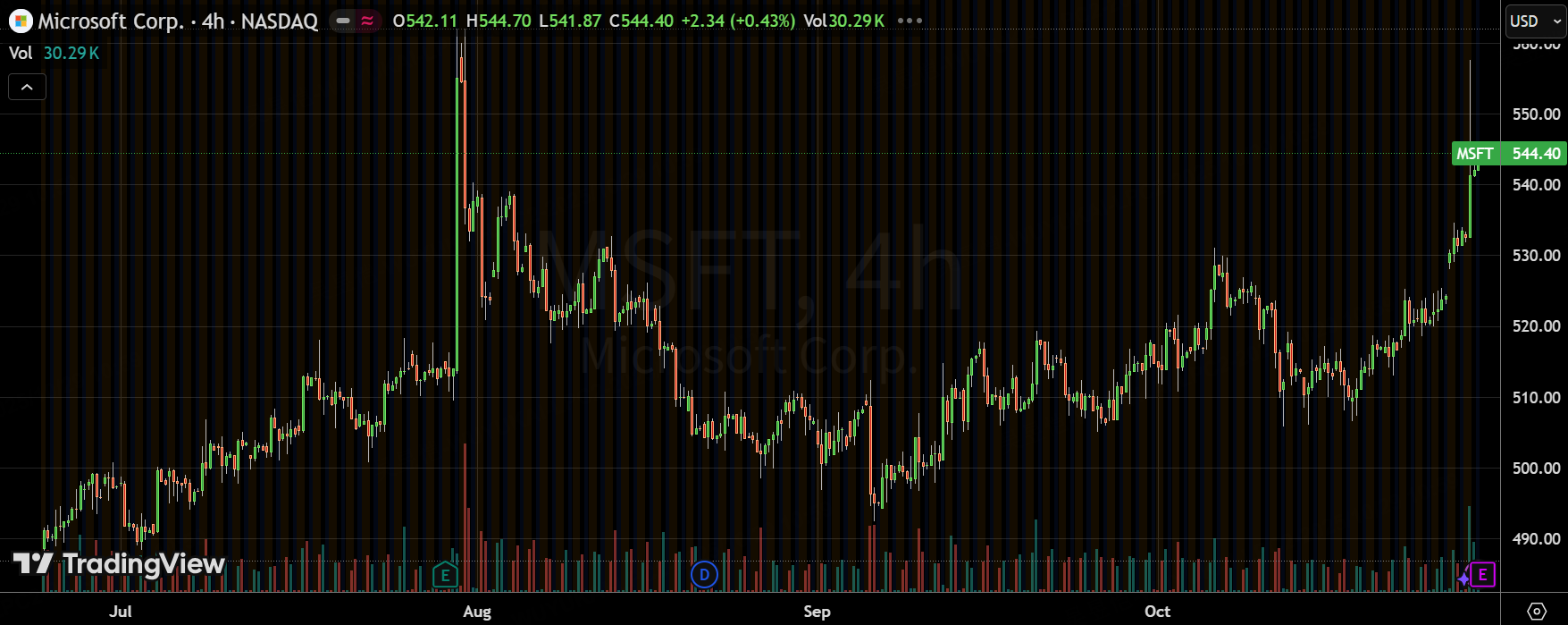
Following the announcement, MSFT shares edged higher as market analysts began revising target prices upward (e.g., Morgan Stanley cited "strengthened AI moat"). Potential caution may be warranted regarding the risk of OpenAI's prior losses ($13.5 billion) being passed on. Compared to NVIDIA's hardware dominance, Microsoft's "software + cloud" model offers greater sustainability, with AI revenue projected to contribute over 20% by 2026.
The current forward P/E ratio of over 35 is not excessive.
Disclaimer: Investing carries risk. This is not financial advice. The above content should not be regarded as an offer, recommendation, or solicitation on acquiring or disposing of any financial products, any associated discussions, comments, or posts by author or other users should not be considered as such either. It is solely for general information purpose only, which does not consider your own investment objectives, financial situations or needs. TTM assumes no responsibility or warranty for the accuracy and completeness of the information, investors should do their own research and may seek professional advice before investing.
- Merle Ted·2025-10-29$600 per share in 24h time!1Report
- Enid Bertha·2025-10-29Any chance that it can go down if the earnings are not good ?1Report
- gleezy·2025-10-29What insightful perspective! 💡 Love it1Report