


AMD Aims for $300: Three Option Strategies to Position for Potential Gains
Several top investment banks, including Bank of America and HSBC, have significantly raised their price targets for $AMD$, with BofA lifting its target to $300 and reiterating its "Buy" rating. This optimism is not unfounded; it's based on strong signals from the recent OCP Global Summit and AMD's unprecedented growth visibility in both AI and traditional computing markets. Institutions widely believe AMD is positioned at the forefront of a multi-trillion dollar market, with significant re-rating potential for its stock price.
Milestone Collaboration with OpenAI Opens AI Revenue Ceiling
The core foundation for institutions' bullish $300 target for $AMD$ is its strategic partnership with OpenAI. This multi-year agreement plans to deploy up to 6GW of AMD Instinct GPUs. The implications are profound.
According to HSBC estimates, this deal could represent a long-term revenue opportunity of approximately $80-$100 billion for $AMD$, equivalent to over 10 times its projected 2025 AI GPU revenue. Although market consensus has raised expectations, institutions believe the current stock price still doesn't fully reflect the massive scale of this collaboration.
BofA's report notes that even under conservative assumptions (only 50% realization of OpenAI's deployment plan), $AMD$'s share of the AI accelerator market would significantly increase from 3-4% in 2024 to over 5.4% by 2027. If fully realized, market share could potentially reach 7.5%. Considering the AI accelerator market is projected to be worth $430 billion by 2027, each percentage point of market share translates to billions in revenue.
Based on the certainty of the OpenAI collaboration, BofA forecasts that if fully realized, $AMD$'s EPS could reach $10-$11 by 2027. The new $300 price target is derived by applying a 33x P/E multiple to 2027 estimated EPS – a valuation not considered excessive – demonstrating the solid foundation of its profit forecasts.
Next-Generation Product Visibility Increases, Building Long-Term Competitive Moats
The 2025 OCP Summit served as a stage for $AMD$ to demonstrate the strength of its technology roadmap, particularly bringing exceptional clarity to the deployment prospects of the MI450 series 'Helios' racks in H2 2026. This yields several key benefits:
Chip-to-Rack Upgrade: $AMD$ is transitioning from a mere GPU supplier to a leader providing complete rack-scale solutions. This system-level delivery capability commands higher average selling prices and deeper customer lock-in, evidenced by support from key industry clients like Oracle and Meta.
Maturing Supply Chain & Ecosystem: Although execution risks exist for the 'Helios' rack as a new product scaling into mass production, positive announcements at the OCP Summit bolstered institutional confidence in timely delivery. Meanwhile, continuous improvements to the ROCm software ecosystem are gradually narrowing the gap with the industry leader, removing barriers to large-scale adoption.
Strong Foundation and Sustained Growth in Traditional CPU Business
Beyond the AI spotlight, $AMD$ maintains a strong competitive edge against Intel in its traditional strongholds – the server and PC CPU markets:
Server Market: $AMD$'s EPYC processors continue to gain share due to Intel's disadvantages in core count, power consumption, and Total Cost of Ownership. Crucially, as data centers increasingly adopt rack-scale solutions integrating AI accelerators, $AMD$'s advantage in CPU-accelerator co-design is further amplified – an area where Intel lags.
PC Market: $AMD$'s Zen 5 architecture processors remain highly competitive, and the anticipated lead in launching the next-generation Zen 6 "Medusa" architecture is expected to further solidify its leadership in the desktop market, providing a stable source of cash flow.
Institutions generally predict that $AMD$'s upcoming quarterly earnings report and guidance will be very strong, potentially exceeding market expectations. Accelerating data center GPU revenue (e.g., MI355 series) and a recovery in server upgrade demand are key drivers. Additionally, the Analyst Day scheduled for November is seen as a critical catalyst for $AMD$ to release more positive news and update its long-term financial model.
Technical Trends
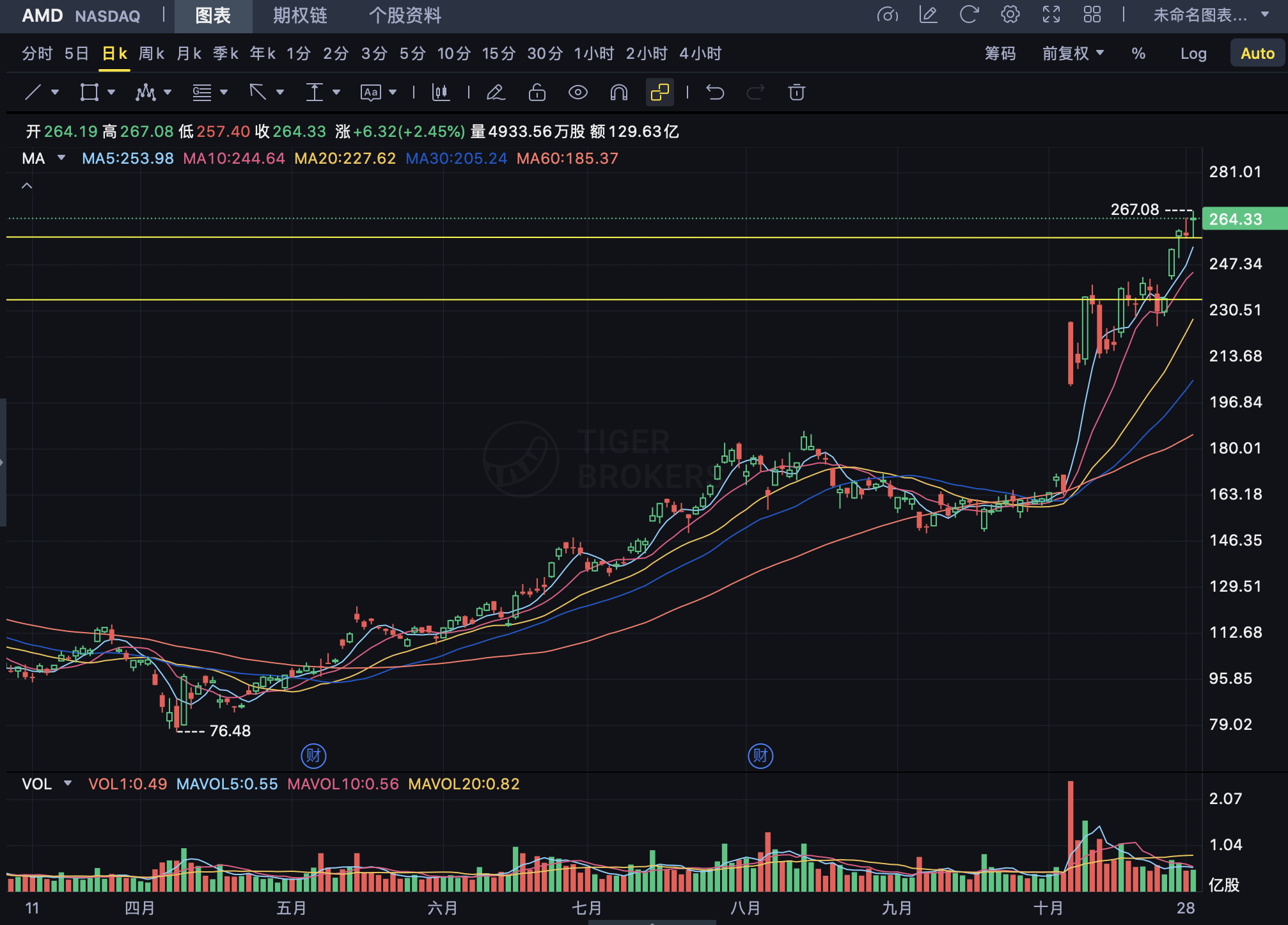
$AMD$ is currently in a phase testing a key resistance breakout. The short-term technical picture shows a bullish "breakout from consolidation with supportive volume," but needs to watch resistance near the previous high of $267. Core support below lies at $234.75. Close attention should be paid to volume changes and institutional positioning.
Option Strategies
The $AMD$ options structure shows concentrated Call open interest in the 270–300 range, with significant new volume peaks around strikes of 270, 280, 285, and 300. This indicates the market is betting short-term on $AMD$ breaking above 270 and challenging 285–300.
Thus, the primary market expectation for November is "pushing towards 300, but likely via volatile upward movement." If macro liquidity or NVDA earnings provide a catalyst, a brief break above 300 is possible; otherwise, trading may mostly oscillate in the 260–285 range.
Given this expectation, three option strategies are available for consideration:
1. Sell Put
Ideal if strongly bullish, believing $AMD$ won't fall significantly. Generate income by selling puts. If the stock rises or trades sideways, you keep the premium. If it falls sharply and assignment occurs, you buy shares at a lower price.
Trade Selection: Sell 1 $AMD 20251219 250.0 PUT$
Net Cost: Selling options generates a credit.
Potential Profit: Max Profit = Premium Received = $1690 (for 1 contract).
Profit Scenario: AMD stock price ≥ $250 at expiration. Profit is $1690 whether the stock is at $251 or $300.
Potential Loss:
Breakeven Point = Strike Price - Premium = $250 - $16.9 = $233.1. Losses begin if price is below $233.1.
E.g., Stock at $220: Loss = ($250 - $220) * 100 - $1690 = $3000 - $1690 = $1310.
Rationale & Risk: A "moderately bullish" or "neutral/bullish" strategy with high win probability in up/steady markets. Profit is capped at the premium, missing out on gains if $AMD$ surges far above $300. Risk involves significant loss if $AMD$ crashes (e.g., poor earnings), equivalent to the loss from being assigned 100 shares.
2. Sell Put + Buy Call (Reduced-Cost Bullish Position)
Constructs a bullish position at a lower net cost or for a credit, offering unlimited upside potential while defining the entry price if assigned.
Trade Selection:
Sell 1 $AMD 20251219 250.0 PUT$ | Premium: $16.90
Buy 1 $AMD 20251219 290.0 CALL$ | Premium: $15.60
Net Cost: Net Credit = -$1560 + $1690 = +$130 (You receive $130 net).
Potential Profit: Unlimited upside if stock price rises significantly above $290. The long call profits once price exceeds $290.
Potential Loss: Occurs if the stock price falls sharply. If price is below $250 at expiration, you are obligated to buy 100 shares at $250, and the $290 call expires worthless.
Rationale & Risk: A strongly bullish strategy aiming to participate in major upside with controlled risk/cost. The put premium subsidizes/sometimes fully covers the call cost, lowering the barrier to entry. Offers unlimited profit potential if $AMD$ surges. Requires readiness to purchase shares at $250 if the price declines, needing sufficient margin/capital.
3. Bull Call Spread
A defined-risk strategy that finances the purchase of a lower-strike call by selling a higher-strike call, capping both potential profit and loss.
Trade Selection:
Buy 1 $AMD 20251121 280.0 CALL$ | Premium: $12.60
Sell 1 $AMD 20251121 310.0 CALL$ | Premium: $5.35
Net Cost/Debit: Net Debit = $1260 - $535 = $725 (This is also the Maximum Potential Loss).
Potential Profit:
Max Profit = (Higher Strike - Lower Strike) * 100 - Net Debit = ($310 - $280) * 100 - $725 = $3000 - $725 = $2275.
Profit Scenario: AMD stock price ≥ $310 at expiration. Profit is $2275 whether the price is $310 or $350.
Potential Loss: Max Loss = Net Debit = $725. Loss Scenario: AMD stock price ≤ $280 at expiration. Loss is $725 whether the price is $270 or $200.
Rationale & Risk: A risk-controlled, cost-effective strategy. For $725, you gain exposure to the $30 move from $280 to $310. Offers attractive returns if $AMD$ rises steadily (e.g., on strong earnings/Analyst Day) but doesn't explode higher. Maximum loss is known upfront, reducing psychological pressure. The major drawback is forfeiting all profits above $310, "capping" significant potential upside.
Disclaimer: Investing carries risk. This is not financial advice. The above content should not be regarded as an offer, recommendation, or solicitation on acquiring or disposing of any financial products, any associated discussions, comments, or posts by author or other users should not be considered as such either. It is solely for general information purpose only, which does not consider your own investment objectives, financial situations or needs. TTM assumes no responsibility or warranty for the accuracy and completeness of the information, investors should do their own research and may seek professional advice before investing.
- Venus Reade·2025-10-31AMD was expected to drop further and test the 250 level, but it held strong and rebounded following solid earnings from Amazon, Apple, and Western Digital.LikeReport
- Enid Bertha·2025-10-31before ER report, AMD is not going to have a big drop, that's the baseline.LikeReport
- breezyk·2025-10-30This strategy sounds well thought outLikeReport